ELECTRICITY
WHAT IS ELECTRICITY?

Elecrticity is all around us powering technology like our phones, computers, ligths, soldering iron and air conditioners. it´s tough to escape it in our modern world. Even when you try to escape electricity, its still at work throughout nature from the lightning in a thunderstorm to the synapses insideour body. But what exactly is electricity?This is very complicated question, and as you dig deeper and ask more questions, there really is not a definitive answer, only abstract representation of how electricity interacts with our surroundings.
1. Basic of electricity:
-The fundamental electric quantity is charge. -Atoms are composed of charge carrying particles: electrons, protons and neutral particles or neutrons. -The smallest amount of charge that exists is carried by an electron and a proton.
- Voltage is the difference in charge between two points.
- Current is the rate at which charge is following.
- Resistance is a material's tendency to resist the flow of charge (current)

OHM'S LAW:
The Ohm's law is a basic unit of the electrical circuits.It establishes that the potential difference V that we apply between the ends of a determined conductor is proportional to the intensity of the current I that circulates through said conductor. Ohm completed the law introducing the motion of electrical resistance R; which is the proportionality factor that appears in the relationship between V I:
V=R·I
Georg Simon Ohm:

2.WHAT IS A CIRCUIT?
An electrical circuit is a path or line through which an electrical current flows. The path may be closed (joined at both ends), making it a loop. A closed circuit make electrical current flow possible. It may also be an open circuit where the electron flow is cut short because the path is broken. An open circuit does noy allow electrical current to flow.
Circuits have different components:

- Capacitors
- Resistors
- Inductors
- LEDs
- Integrated Circuits
- Motor
- Wires
- Lamps...
There are different types of circuits and systems:
-PARALLEL CIRUITS:
- In a parallel circuit, there is more than one resistor (bulb) and they are arranged on many paths. This means electricity (electrons) can travel from one end of the cell through many branches to the pther end of the cell.
-SERIES CIRCUITS:
- A series circuit is one that has more than one resistor, but only one path through which the electricity (electrons) flows. From one end of the cell (battery)´the electrons move along one path with NO branches, through the resistors, to the other end of the cel. The components in a series circuit are connected end-to-end.
-MIXED SYSTEM:
- An economic system in which both the private enterprise and a degree of state monopoly (usually in public services, defense, infrastructure and basic industries) coexist. All modern economies are mixed where the means of production are shared between the private and public sectors. Also called dual economy.
Series circuit:
Resistance:




Capacitors:

Parallel circuits:
Resistances:

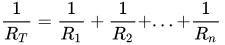
Generator:


Capacitors:

Mixed circuits:
This circuit is special because is the union of parallel circuit and the series circuit. Its the union of operations of those circuits.

- Here there is a video of how a mixed circuit is resolved:
- Here there is a video of how a parallel circuit is resolved:
https://www.youtube.com/watch?v=C1YRq4sMSPQ
- Here there is a video of how a serie circuit is resolved:
END!
Lucas y espero que Jorge también.
ResponderEliminarEsto ha mejorado bastante. Podéis dejarlo así, o hacer 3 entradas diferentes y mejorarlo, resolviendo 3 ejemplos reales para los tipos de circuito. Me decís
Pero si lo dejamos asi estaremos aprobados?
ResponderEliminar